Underwater Welding School Cost and Salary 2026: Is the Risk Worth the Reward?
Imagine a job where your office is 300 feet below the surface, your commute involves a decompression chamber, and a single mistake with differential pressure could be fatal. This is the reality of underwater welding—often cited as one of the world’s most dangerous, yet financially rewarding, professions.
For many looking to escape the 9-to-5 grind, the allure of high pay and adventure is irresistible. But before you dive in, you need to understand the underwater welding school cost and salary 2026 landscape. The financial barrier to entry is higher than most trade schools, and the pay structure is often misunderstood.
Here is the truth about the costs, the realistic salary expectations for 2026, and the “hidden” apprenticeship phase that most brochures won’t tell you about.
The Reality of Hyperbaric Welding
First, a critical clarification: there is technically no such thing as “underwater welding school” in isolation. You cannot simply take a two-week welding course and jump into the ocean.
To become an underwater welder, you must first become a certified commercial diver.
The industry standard requires you to attend a commercial diving academy. There, you learn physics, physiology, dive medicine, and salvage operations. Underwater welding is just one module within a much larger curriculum.
Wet Welding vs. Dry Welding
-
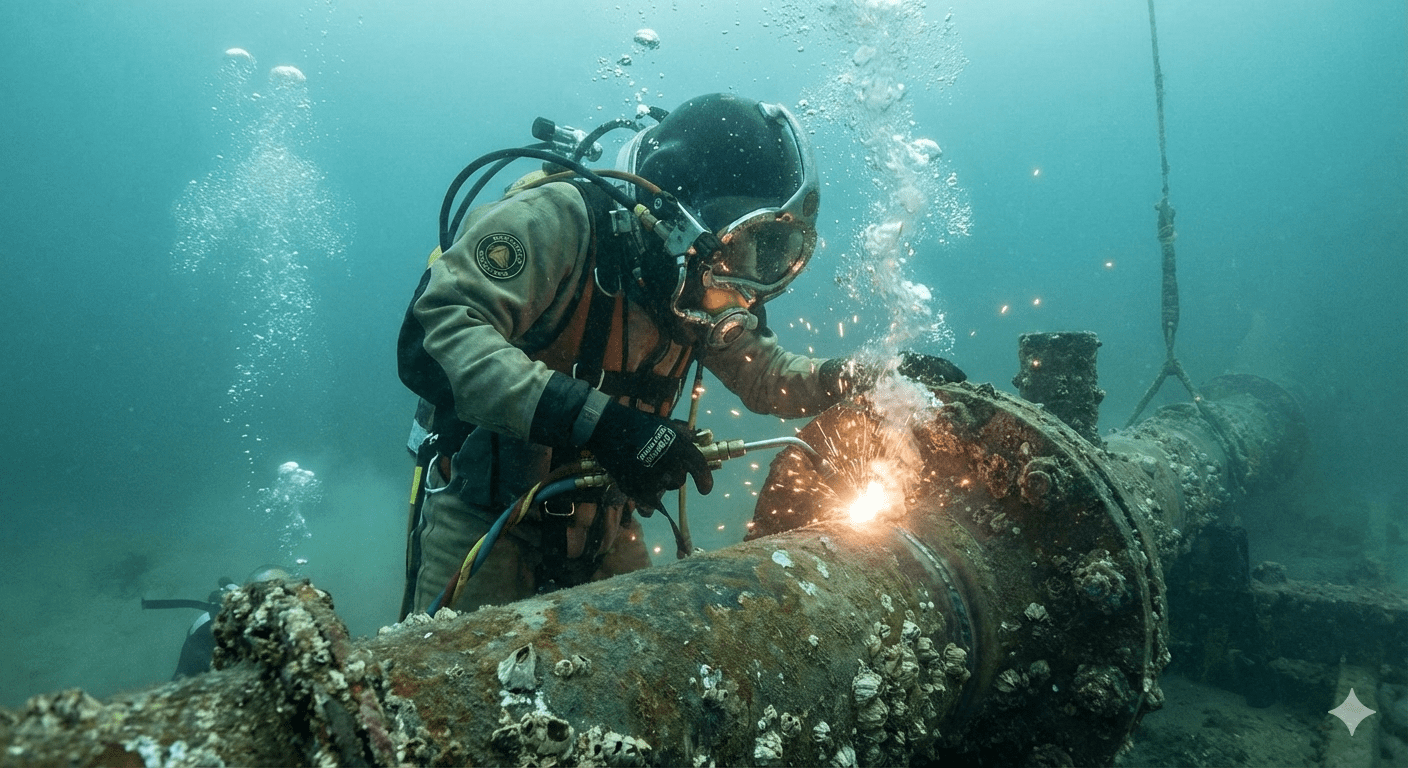
Wet Welding: Performed directly in the water. The welder uses a special waterproof electrode. This is common for emergency repairs but produces lower-quality welds due to rapid cooling.
-
Dry (Hyperbaric) Welding: Performed inside a dry habitat chamber sealed around the structure. The chamber is filled with gas to push the water out. This produces high-quality, code-standard welds and is where the highest salaries are found.
Analyzing the Underwater Welding School Cost and Salary 2026
If you are planning your finances for 2026, you need to look beyond just the tuition sticker price.
The Investment: School Costs Breakdown
In 2026, the average cost for a reputable commercial diving program in the United States ranges from $25,000 to $35,000.
However, the total investment is often higher when you factor in hidden costs. Here is a realistic breakdown for a 5-to-7 month program:
| Expense Category | Estimated Cost (2026) | Notes |
| Tuition | $25,000 – $34,000 | Covers core diving and welding modules. |
| Dive Gear | $2,000 – $4,000 | Wetsuits, fins, knives, and bail-out bottles. |
| Physical Exams | $300 – $600 | Required ADCI commercial diving physical. |
| Housing/Living | $8,000 – $12,000 | Most schools do not include room and board. |
| Books/Certifications | $500 – $1,000 | AWS and ADCI card processing fees. |
| Total Estimated Cost | $35,800 – $51,600 |
Financial Aid Note: Because most legitimate commercial diving schools are accredited, they are eligible for Federal Financial Aid (FAFSA) and veteran benefits like the GI Bill.
The Return: Salary Expectations
This is where most people get confused. The internet often claims underwater welders make $300,000 a year. While that is possible, it is statistically rare and reserved for the top 1% of saturation divers.
According to data trends from the Bureau of Labor Statistics (BLS) and industry surveys, here is a more realistic salary trajectory for 2026:
1. The “Tender” Phase (Years 1–2)
Salary: $35,000 – $45,000
Fresh out of school, you will not be diving. You will be a “Dive Tender.” Your job is to pull hoses, clean gear, and manage the topside operations for the divers in the water. This is a grueling apprenticeship designed to weed out those who can’t handle the lifestyle.
2. The Commercial Diver (Years 3–5)
Salary: $55,000 – $80,000
Once you break out as a diver, your pay increases. You will perform inspections, salvage, and occasional wet welds. Most of your money here comes from “depth pay” and overtime.
3. The Saturation Diver (The Elite)
Salary: $100,000 – $200,000+
Saturation diving involves living in a pressurized chamber for weeks at a time. It is physically devastating but incredibly lucrative. These professionals are the ones earning the viral salary figures you see online.
Pro Tip: In 2026, “depth pay” is still the primary bonus. You might earn a base hourly wage, plus $1 to $4 per foot of seawater depth.
Requirements and Prerequisites
Before you apply for a loan, ensure you meet the strict physical and mental requirements.
1. The ADCI Physical
You must pass a rigorous medical exam approved by the Association of Diving Contractors International (ADCI). Conditions that might disqualify you include:
-
Asthma or history of collapsed lung.
-
Chronic ear infections or sinus issues.
-
Claustrophobia.
-
Certain heart conditions.
2. Swimming Ability
You do not need to be an Olympic swimmer, but you must be comfortable in the water. Schools typically require you to swim 400 meters without stopping and tread water for 10–15 minutes.
3. Mechanical Aptitude
Can you fix a car engine? Can you read a blueprint? Diving is only the commute; the work is construction. If you are mechanically inclined, you will have a significant advantage over a classmate who is just a good swimmer.
The Risks: What You Are Paying For
When calculating the underwater welding school cost and salary 2026, you must factor in the physical toll. High pay is essentially hazard pay.
Delta P (Differential Pressure)
This is the most feared hazard in the industry. When two bodies of water with different water levels intersect (like a drain in a dam), it creates a suction force that no human can escape. If a diver gets too close, they can be trapped instantly.
Decompression Sickness (“The Bends”)
Despite modern dive tables and computers, the risk of nitrogen bubbles forming in the bloodstream remains. This can cause joint pain, paralysis, or death.
Long-Term Health Effects
Many veteran divers retire early due to dysbaric osteonecrosis (bone damage from pressure) or hearing loss. This limits your career lifespan, meaning you have a shorter window to earn your money compared to a standard trade.
2026 Trends: Robotics vs. Human Divers
What happens next depends on one key factor: Automation.
As we move further into the decade, ROVs (Remotely Operated Vehicles) are taking over deeper, more dangerous inspection jobs. However, robots still struggle with complex manipulation and welding tasks in tight spaces.
The shift for 2026:
-
Hybrids: Divers who can also pilot ROVs are in high demand.
-
Inland vs. Offshore: Offshore oil rig work is volatile. Inland diving (bridges, dams, nuclear power plants) is becoming more stable and offers a better work-life balance, though typically at a lower daily rate.
Alternatives to Underwater Welding
If the cost or risk seems too high, consider these adjacent career paths that offer strong ROI:
-
Non-Destructive Testing (NDT) Inspector:
You use ultrasound and X-rays to test welds. You can do this underwater or topside. It pays well and is less physically demanding than welding.
-
Topside Pipe Welder:
With the infrastructure bills passing globally, topside welders are in high demand. You can earn $80,000+ with overtime, without ever getting wet.
-
ROV Pilot/Technician:
Operate the robots that are replacing divers. This requires electronics training but keeps you dry and safe in the control room.
Frequently Asked Questions (FAQ)
1. Is it worth going to underwater welding school in 2026?
Yes, but only if you are willing to travel and work specifically as a “commercial diver.” If you expect to graduate and immediately earn six figures welding underwater, you will be disappointed. The value lies in the long-term career of marine construction.
2. Can I get a grant for underwater welding school?
Yes. Since most commercial diving schools are accredited, you can apply for the Pell Grant via FAFSA. Additionally, trade-specific scholarships like those from the American Welding Society (AWS) can help offset costs.
3. How long does the schooling take?
A full Commercial Diver certification program typically takes 5 to 7 months to complete if attending full-time.
4. Do I need to be a certified welder before joining diving school?
No. Most diving schools teach you welding from scratch. However, having a topside welding certification (like AWS D1.1) beforehand gives you a massive advantage in the job market.
5. What is the age limit for underwater welding?
There is no strict legal age limit, but the physical demands make it a young person’s game. Most divers start in their 20s and transition to supervisory or topside roles by their mid-40s.
6. Where are the highest paying jobs located?
The Gulf of Mexico (USA) and the North Sea (Europe) are the hubs for high-paying offshore oil and gas work.
Conclusion
The landscape of underwater welding school cost and salary 2026 presents a high-risk, high-reward equation. With school costs hovering around $30,000 and entry-level pay starting near $40,000, the immediate ROI is modest. However, for those with the grit to endure the “tender” years and the skill to master hyperbaric welding, the career offers financial freedom that few other trades can match.
If you are ready to proceed, your next step is to research schools accredited by the Association of Diving Contractors International (ADCI) or verify welding certifications through the American Welding Society (AWS).