PMP Certification Cost vs Salary Increase 2026: Is the Investment Worth It?
In the current economic climate, career stagnation is a silent killer. You might be managing complex projects, leading cross-functional teams, and delivering results, yet your salary remains flat while inflation climbs. For many project professionals, the solution seems obvious: get certified. But is the Project Management Professional (PMP)® designation still the golden ticket it used to be?
As we move into 2026, the financial landscape of certification has shifted. Training prices have fluctuated, exam fees have evolved, and, most importantly, the salary premium for certified managers has hit new benchmarks. This article provides a brutally honest breakdown of the PMP certification cost vs salary increase 2026, helping you decide if the returns justify the upfront investment.
The “Price Tag” Shocker: What It Actually Costs in 2026
Many aspirants budget for the exam fee and forget the rest. This is a mistake. To understand the true cost of becoming a PMP, you must look at the “Total Cost of Ownership,” which includes training, membership, and materials.
1. The Core Exam Fees
The Project Management Institute (PMI) maintains a two-tier pricing structure.
-
PMI Members: $405 USD
-
Non-Members: $555 USD
Here’s where most people get confused: It is almost always cheaper to become a member first. The PMI membership costs approximately $139 ($129 + $10 application fee).
-
Math: $405 (Exam) + $139 (Membership) = $544.
-
Savings: You save $11 compared to the non-member price, plus you get a free digital copy of the PMBOK® Guide (Project Management Body of Knowledge), which serves as your primary study resource.
2. The Training Requirement (35 Contact Hours)
You cannot simply walk into the exam center; you must prove you have completed 35 hours of formal project management education. This is where costs vary wildly:
-
On-Demand Online Courses: $15 – $200. Platforms like Udemy or Coursera are cost-effective but require high self-discipline.
-
Live Virtual Bootcamps: $1,000 – $2,500. These offer structure and instructor interaction but come at a premium.
-
University Programs: $3,000+. Often unnecessary unless you are seeking university credits.
3. Hidden Costs
This detail often gets overlooked. To be safe, budget for these “invisible” expenses:
-
Study Guides: $40 – $100 (e.g., Rita Mulcahy’s book or equivalent).
-
Exam Simulators: $60 – $150. Essential for practicing the tricky situational questions.
-
Retake Fees: If you fail your first attempt, it costs $275 (Member) or $375 (Non-Member) to try again.
The Payoff: PMP Salary Trends in 2026
Now, let’s look at the income side of the equation. Does a piece of paper really change your bank balance?
According to the latest data projections based on PMI’s Earning Power: Project Management Salary Survey (13th Edition trends) and 2026 market analysis, the answer is a resounding yes—but with caveats.
The “PMP Premium”
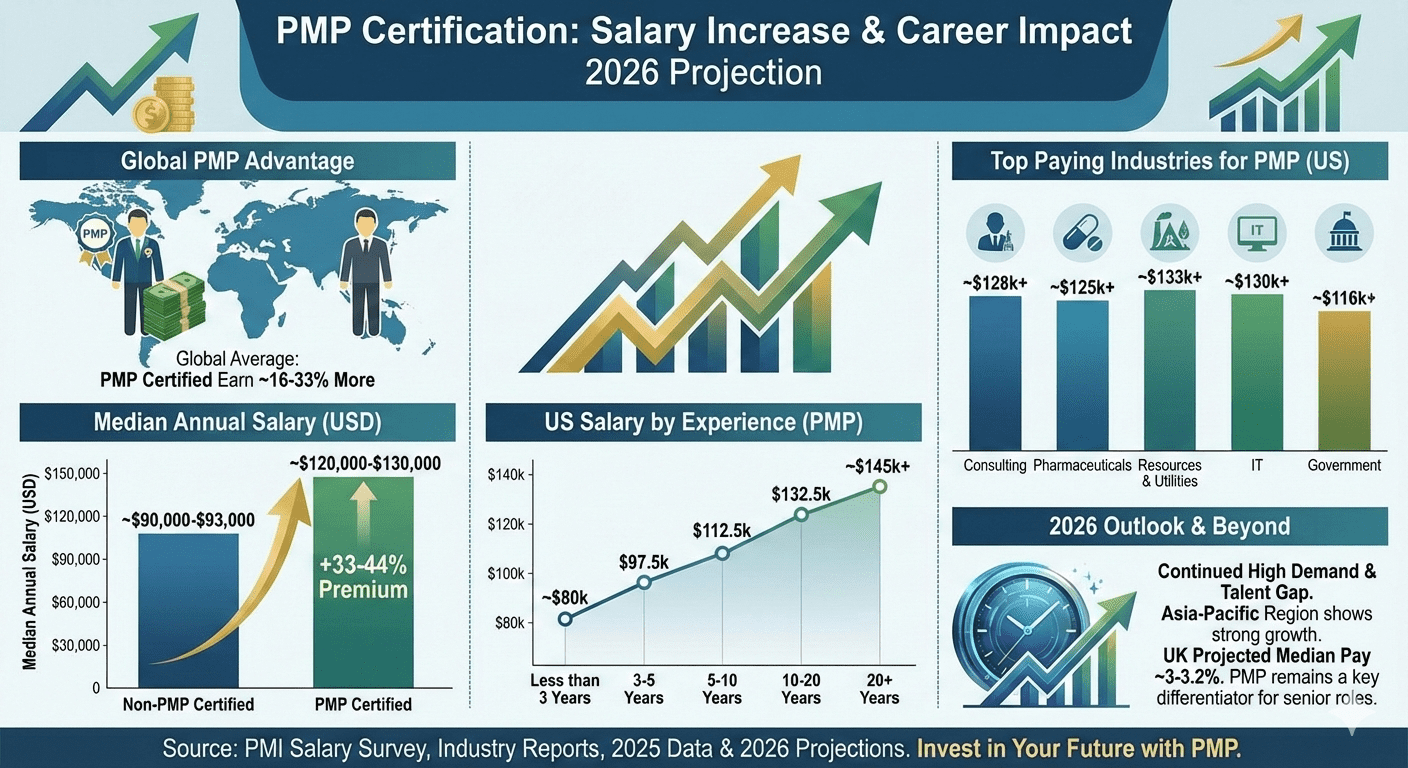
Globally, PMP certification holders earn significantly more than their non-certified counterparts. The gap is widening as organizations prioritize standardized methodologies like Agile and Hybrid delivery.
-
Global Average: PMP holders earn approximately 16% to 33% more than non-PMP project managers.
-
United States: The median salary for PMP holders hovers around $130,000 – $135,000, compared to $105,000 for non-certified managers. That is a $25,000+ annual difference.
-
United Kingdom: The premium is roughly 15-20%, with certified senior PMs often breaking the £75,000+ barrier.
Industry Variations
Your industry dictates your ceiling. In 2026, the highest ROI for PMPs is found in:
-
IT & Software Development: High demand for Agile-certified PMPs.
-
Healthcare & Pharma: Strict regulatory environments require formal PM rigor.
-
Construction & Engineering: Traditional waterfall methodologies remain dominant here.
PMP Certification Cost vs Salary Increase 2026: The ROI Analysis
This section addresses your core query directly. Let’s run the numbers for a typical US-based professional to see how quickly the investment pays for itself.
The Scenario
-
Total Investment: $2,000 (Assuming $544 for Exam/Membership + $1,200 for a decent Bootcamp + $256 for materials).
-
Salary Increase: $20,000 (Conservative estimate based on the $25k median gap).
The Calculation
If you secure a raise or a new job with a $20,000 bump, your monthly pre-tax income increases by roughly $1,666.
Break-Even Point: $2,000 (Cost) ÷ $1,666 (Monthly Gain) = 1.2 Months.
Even if you spend $3,000 on high-end training and only get a $10,000 raise, your break-even point is under 4 months. In the world of financial investments, a return of 10x in the first year is virtually unheard of—yet that is the standard ROI for the PMP.
Eligibility: Can You Even Apply?
Before you get excited about the salary, ensure you are eligible. PMI is strict about who sits for the exam.
Category A: Four-Year Degree Holders
-
Experience: 36 months of unique, non-overlapping professional project management experience.
-
Education: 35 hours of project management education (the training mentioned above).
Category B: High School Diploma / Associate Degree
-
Experience: 60 months of unique professional project management experience.
-
Education: 35 hours of project management education.
Risk Warning (The Audit): PMI randomly selects applications for an audit. If selected, you must provide copies of your degree, signatures from supervisors verifying your experience, and certificates for your training. If you cannot provide these, you will fail the audit and forfeit your fees (minus a processing charge). Never fabricate your experience.
Alternatives to PMP: Are They Cheaper?
If the PMP seems too expensive or you don’t meet the experience requirements, consider these alternatives.
1. CAPM (Certified Associate in Project Management)
-
Best For: Entry-level PMs with no experience.
-
Cost: ~$300 (Total).
-
Salary Impact: Minimal. It helps you get the first job, but doesn’t command a premium.
2. PRINCE2 (Projects IN Controlled Environments)
-
Best For: Professionals in the UK, Europe, and Australia.
-
Cost: Comparable to PMP but often split into Foundation and Practitioner levels.
-
Salary Impact: High in specific regions, low in the US.
3. Agile Certifications (CSM, PMI-ACP)
-
Best For: Software and IT sectors.
-
Cost: $400 – $1,000.
-
Salary Impact: Very high in tech, but less versatile than PMP.
Frequently Asked Questions (FAQ)
1. Does the PMP exam fee include training?
No. The exam fee paid to PMI covers only the testing seat. You must pay a third-party provider or purchase a course separately to fulfill the 35-contact-hour requirement.
2. Will my company pay for my PMP?
Many employers have professional development budgets. It is highly recommended to present the “ROI Analysis” section of this article to your manager. Explain that PMP certification reduces project failure rates, which saves the company money.
3. How hard is the PMP exam in 2026?
The exam remains difficult. It focuses heavily on situational questions (e.g., “What should the project manager do next?”). It covers three domains: People (42%), Process (50%), and Business Environment (8%). Rote memorization of terms is no longer enough to pass.
4. Do I need to renew the certification?
Yes. You must earn 60 Professional Development Units (PDUs) every three years and pay a renewal fee (approx. $60 for members). This ensures your skills stay current.
5. Can I prepare for the PMP on my own to save money?
Yes. You can buy a low-cost Udemy course for the 35 hours and self-study using books. This can bring your total cost down to under $700. However, the failure rate is generally higher for self-study candidates without a structured study plan.
Conclusion: The Verdict
When analyzing the PMP certification cost vs salary increase 2026, the data paints a clear picture. While the upfront cost of $600 to $2,500 can feel steep, the potential salary increase of 16-33% makes it one of the best investments a professional can make.
However, the certification is not a magic wand. It validates experience you already have; it does not replace it. The real value of the PMP in 2026 lies in its ability to get your resume past Applicant Tracking Systems (ATS) and position you for leadership roles that non-certified PMs simply cannot access.
If you have the experience and the drive, the financial risk is minimal compared to the career reward.